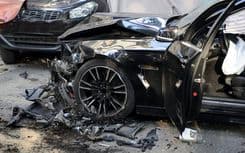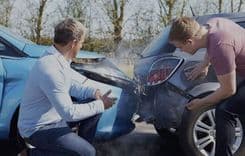


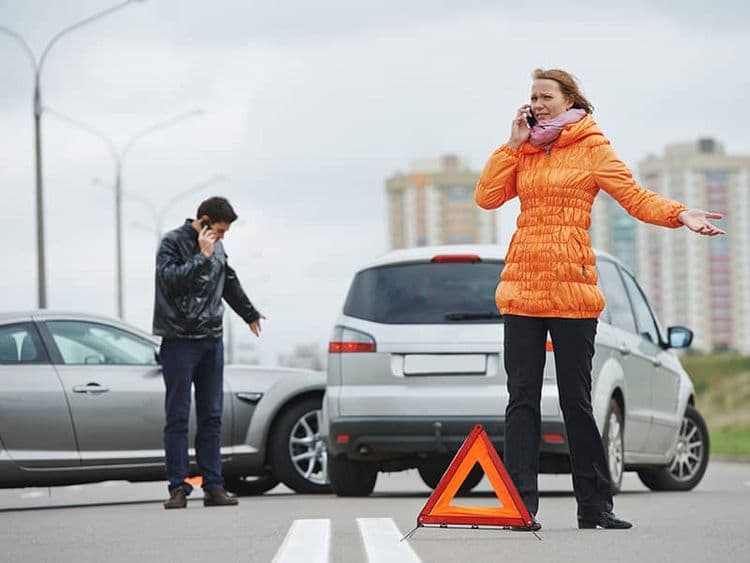
Determining fault in a traffic accident is not a matter of opinion; it is about applying THE HIGHWAY CODE.
Here are the practical criteria used to decide who is responsible:
1. The Liability Table
If your accident fits into one of these categories, fault is clear:
- Rear-end collision: The driver who hits from behind is always at fault for failing to maintain a safe following distance, even if the vehicle in front brakes suddenly.
- Reversing: A vehicle moving in reverse is at fault in 100% of cases.
- Leaving a parking space / Garage: A vehicle entering the flow of traffic must yield right of way; if a collision occurs, they are responsible.
- Lane invasion: If a car hits another while changing lanes, the one performing the manoeuvre is at fault.
- Priority signs (Stop or Give Way): The driver who ignores the sign is responsible, without question.
2. The Roundabout Scenario (The Malaga "Classic")
In complex roundabouts like Fuente de los Colorines or those in Teatinos, the rules are strict:
- Fault of the driver in the inner lane: If a driver attempts to exit the roundabout directly from the inner lane and cuts across the path of a driver in the outer lane, the driver in the inner lane is at fault.
- Priority: Vehicles already inside the roundabout always have priority over those attempting to enter.
3. Technical Evidence
When a situation is ambiguous, objective evidence is used:
- The Police Report: Officers from the Local Police or Civil Guard act as objective experts. Their accident reconstruction is the evidence with the greatest legal weight.
- Skid marks: These help calculate speed. Excessive speed can turn a "victim" into a "partially at fault" party (contributory negligence).
- Impact points: A collision on the rear side indicates that the car had already almost completely passed, suggesting that the other driver had time to react.
- Traffic Cameras: In Málaga, the Traffic Management Centre has cameras at strategic points that can be requested through legal proceedings.
4. Contributory Negligence (Shared Fault)
Sometimes, liability is not 100% attributed to a single party.
Example: A car runs a Stop sign (primary fault), but the other car was travelling at double the speed limit on Avenida de Velázquez. In these cases, a judge may determine that there is shared fault (for example, 70% - 30%), and compensation is reduced proportionally.
5. What happens if the traffic light was amber?
This is a constant source of dispute.
- Solid amber: This is equivalent to a red light; you must stop. If you cross and collide, you are at fault.
- Flashing amber: This indicates caution but requires you to give way to pedestrians or vehicles coming from priority roads. If a collision occurs, the person facing the flashing amber is usually held responsible for failing to exercise extreme caution.