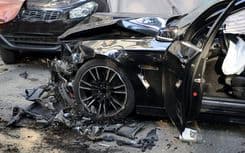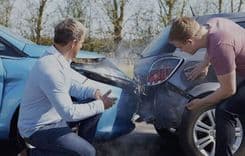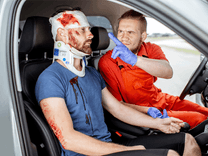



<p>Being involved in a <b>car accident with an uninsured driver</b> can leave me facing unexpected financial, medical, and legal difficulties. If the person responsible has no valid insurance policy, I may wonder whether I can still receive compensation for my injuries and losses.</p>
<p>Fortunately, Spanish law provides mechanisms designed to protect road accident victims, even when the responsible vehicle is uninsured.</p>
<p>One of the most important is the <b>Consorcio de Compensación de Seguros</b>, Spain's Insurance Compensation Consortium.</p>
<p>In this guide, I explain who may be responsible for paying compensation, what damages I can claim, and how I can protect my rights after an accident involving an uninsured vehicle.</p>
<h2>Who Is Responsible for a Car Accident With an Uninsured Driver?</h2>
<p>In Spain, motor vehicles subject to compulsory insurance requirements must have valid third-party liability insurance.</p>
<p>If a driver causes an accident without insurance, the absence of a policy does not automatically remove their legal responsibility.</p>
<h3>Can I Claim Compensation From an Uninsured Driver?</h3>
<p>Yes. If I am injured in an accident caused by an uninsured motorist, I may have the right to claim compensation.</p>
<p>Two important principles apply:</p>
<ul>
<li><b>Personal liability:</b> The responsible driver, and potentially the vehicle owner, may be legally liable for the damage caused.</li>
<li><b>Victim protection:</b> The Spanish Insurance Compensation Consortium may pay compensation in cases covered by the applicable legislation.</li>
</ul>
<p>The uninsured driver may also face administrative penalties for failing to comply with compulsory insurance requirements.</p>
<p>Therefore, discovering that the responsible vehicle is uninsured does not necessarily mean losing my right to compensation.</p>
<h2>How Does the Spanish Insurance Compensation Consortium Work?</h2>
<p>The Consorcio de Compensación de Seguros (CCS) is a Spanish public business entity responsible for several insurance-related functions.</p>
<p>One of its responsibilities is compensating eligible victims of road accidents involving uninsured vehicles.</p>
<h3>What Types of Compensation Can I Receive?</h3>
<p>Depending on the circumstances and applicable legal requirements, I may claim several categories of damages.</p>
<p><b>Personal injuries</b></p>
<p>Compensation may cover temporary injuries, permanent impairments, medical treatment, rehabilitation, and other legally recognised consequences of the accident.</p>
<p><b>Vehicle and property damage</b></p>
<p>I may also claim for repairs or other eligible property losses resulting from the collision.</p>
<p><b>Financial losses</b></p>
<p>If my injuries prevent me from working or generate additional expenses, certain documented financial losses may also be recoverable.</p>
<p>The final amount depends on the circumstances of the accident, the evidence available, and Spain's statutory road accident compensation system.</p>
<h3>Does the Consortium Always Pay?</h3>
<p>Not automatically.</p>
<p>I must establish that the accident falls within the circumstances covered by the Consortium and provide evidence supporting my claim.</p>
<p>Different rules may apply to accidents involving unidentified vehicles, stolen vehicles, or insurers undergoing insolvency proceedings.</p>
<p>The Consortium may also seek reimbursement from the responsible parties after paying compensation in cases involving uninsured vehicles.</p>
<h2>Documents Needed to Claim Compensation</h2>
<p>Preparing a complete claim is essential.</p>
<p>If I suffer an accident involving an uninsured driver, I should collect the following evidence:</p>
<ol>
<li><b>Police accident report:</b> To establish the circumstances of the collision and identify the parties involved.</li>
<li><b>Driver and vehicle information:</b> Including registration number, vehicle details, and available identification.</li>
<li><b>Medical documentation:</b> Emergency records, diagnoses, rehabilitation reports, and medical assessments.</li>
<li><b>Invoices and receipts:</b> Evidence of treatment costs, vehicle repairs, travel expenses, and other losses.</li>
<li><b>Photographs and witness statements:</b> To support my explanation of how the accident occurred.</li>
</ol>
<h3>Why Is Prompt Medical Attention Important?</h3>
<p>After an accident, I should seek medical attention promptly if I experience injuries or symptoms.</p>
<p>Medical records help document the injuries and establish their potential connection with the collision.</p>
<p>Spanish legislation contains specific causation criteria for certain minor cervical injuries, making timely medical assessment particularly important.</p>
<p>Even if my symptoms initially seem minor, delaying medical attention may complicate both my recovery and the supporting evidence for my claim.</p>
<h2>How to Claim Compensation After an Accident With an Uninsured Driver</h2>
<p>I can approach the compensation process through several practical stages.</p>
<h3>Step 1: Verify the Insurance Status</h3>
<p>First, I need to establish whether the responsible vehicle had valid compulsory insurance when the accident occurred.</p>
<p>Official insurance verification procedures can help clarify this issue.</p>
<h3>Step 2: Gather Supporting Evidence</h3>
<p>I collect documents proving the circumstances of the accident, the injuries sustained, and the financial consequences.</p>
<h3>Step 3: Submit My Claim</h3>
<p>I can review the official procedure through the Spanish Insurance Compensation Consortium: https://www.consorseguros.es/</p>
<p>The Consortium provides information about submitting claims for road traffic accidents, including accidents involving uninsured vehicles.</p>
<h3>Step 4: Review the Compensation Assessment</h3>
<p>Compensation for personal injuries is generally assessed under Spain's statutory road accident compensation framework.</p>
<p>I should carefully review whether the assessment includes all eligible injuries, lasting consequences, and documented financial losses.</p>
<h3>Step 5: Seek Specialist Legal Advice</h3>
<p>If liability is disputed or the proposed compensation appears insufficient, specialist legal advice may help me understand my options.</p>
<h2>What If My Own Vehicle Was Also Uninsured?</h2>
<p>If I was driving without compulsory insurance, my legal position may become more complicated.</p>
<p>However, being uninsured does not automatically establish that I caused the accident or eliminate every possible right to compensation.</p>
<p>I must distinguish between responsibility for the collision and the separate consequences of failing to maintain compulsory insurance.</p>
<p>An individual assessment is particularly important in these circumstances.</p>
<h2>How Long Do I Have to Claim Compensation in Spain?</h2>
<p>Time limits are an essential part of any accident claim.</p>
<p>As a general rule, certain civil liability claims are subject to a one-year limitation period in Spain.</p>
<p>However, road traffic accident claims are governed by specific provisions affecting when that period begins and how formal claims may interrupt it.</p>
<p>For personal injuries, the date when the injuries stabilise may be relevant.</p>
<p>I should therefore avoid assuming that the deadline always runs directly from the accident date.</p>
<h2>Conclusion: An Uninsured Driver Does Not Mean No Compensation</h2>
<p>A <b>car accident with an uninsured driver</b> can be stressful, but Spanish law offers important protections for eligible victims.</p>
<p>The Insurance Compensation Consortium may provide compensation when the responsible vehicle lacks compulsory insurance.</p>
<p>My priorities should be to preserve evidence, document my injuries, verify insurance information, and submit the claim correctly.</p>
<p>At <b>Trafilex</b>, I can obtain specialist guidance about road accident compensation claims in Spain.</p>
<p><b>Have you been injured in an accident involving an uninsured driver? Contact Trafilex to understand your rights and explore the compensation you may be entitled to claim.</b></p>